What is Case Management? The Outcome Architect of Modern Healthcare
It’s more than coordination. It’s the strategic bridge between clinical excellence, patient advocacy, and financial sustainability.
At its core, Case Management is a collaborative process of assessment, planning, facilitation, and advocacy. It’s the specialized practice of ensuring a patient doesn’t just "get care," but gets the right care, at the right time, in the right setting.
In a fragmented healthcare system, the Case Manager is the single point of continuity. They are the professional navigators who turn a complex medical diagnosis into a functional, goal-oriented plan for recovery.graph Font
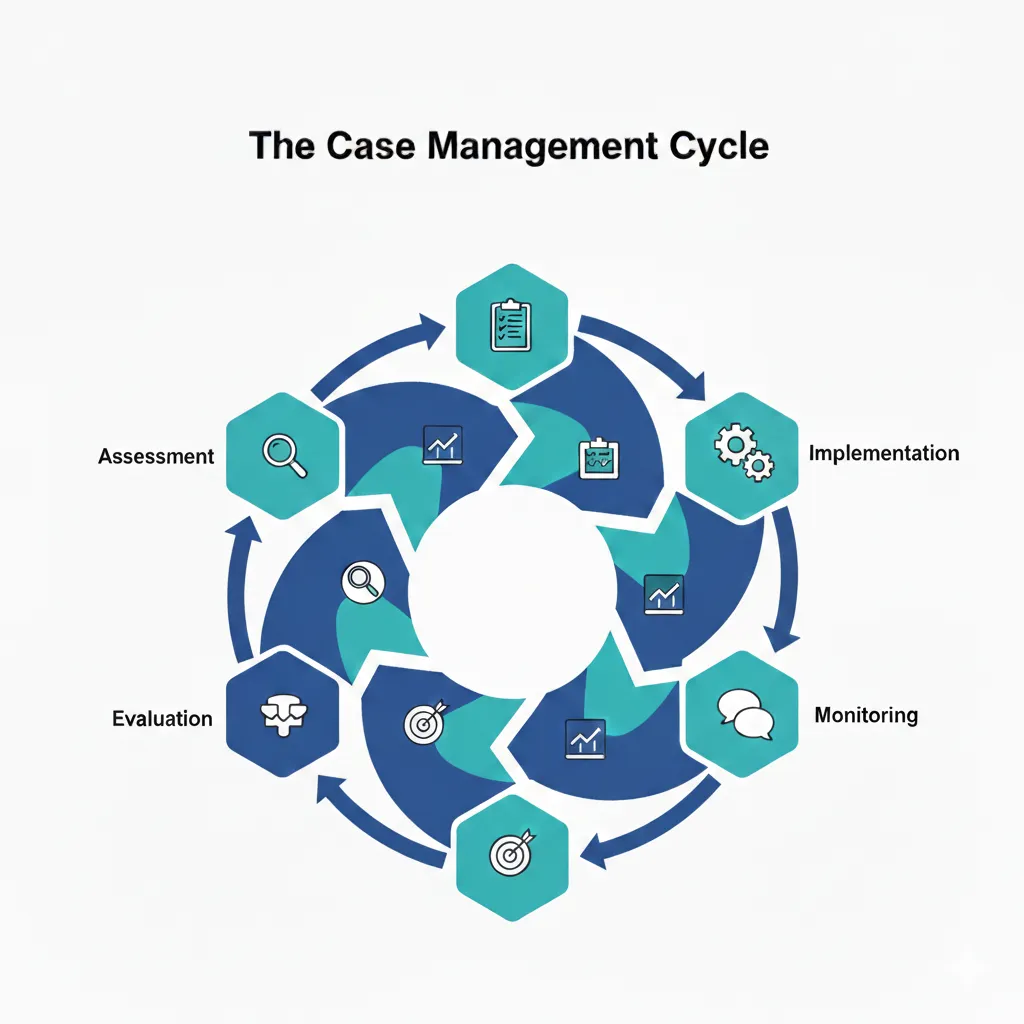
The 6-Step Workflow
The Professional Framework: How It Actually Works
True Case Management follows a rigorous, evidence-based cycle. We break it down into six essential phases:
1. Screening & Assessment: Identifying patients who are at high risk or have complex needs that require specialized intervention.
2. Risk Stratification: Prioritizing resources based on the severity of the case and the potential for positive change.
3. The Care Plan: Developing a roadmap that balances medical necessity with the patient’s personal goals and social situation.
4. Implementation: Coordinating with doctors, insurers, and home-health providers to move the plan from paper to reality.
5. Active Monitoring: Constant evaluation. Is the treatment working? Are there barriers at home? Adjusting the sails in real-time.
6. Outcome Evaluation: Measuring success through clinical recovery, cost savings, and the prevention of hospital readmissions.
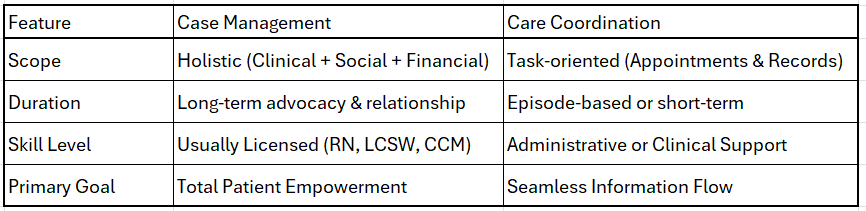
Comparison Table
Case Management vs. Care Coordination: Know the Difference
Pro Tip: People often use these terms interchangeably, but they aren't the same.
The "Why It Matters
Why Case Management is the Engine of Value-Based Care
In today's healthcare economy, "volume" is out and "value" is in. This shift has made Case Managers the most valuable players in the building.
1. Reducing "The Revolving Door": By managing transitions of care, Case Managers slash 30-day readmission rates, saving hospitals millions in penalties.
2. Addressing SDOH: You can’t heal if you don’t have a safe place to sleep. Case Managers bridge the gap between clinical medicine and social determinants of health (housing, food, transport).
3. Advocacy: They are the voice for the patient when the system feels too big to navigate.
FAQ
Do all Case Managers have to be Nurses?
No, but many are. While Registered Nurses (RNs) make up a huge portion of the field, Social Workers (LCSW) and other clinical professionals play massive roles, especially in behavioral health and community settings.
What is a CCM?
The Certified Case Manager (CCM) credential is the gold standard. It proves that a professional has the experience and the "boots-on-the-ground" knowledge to handle complex cases at an elite level.
Title or Question
Describe the item or answer the question so that site visitors who are interested get more information. You can emphasize this text with bullets, italics or bold, and add links.